The first Chebyshev function: when Gauss was a boy (by the dates found on his notes he was approximately 16) he noticed that the primes appear with density around . Then, instead of counting primes and looking at the function , lets weight by the natural density and look at . Since we are weighting by what we think is the density, we expect it to be asymptotic to be . This is the first Chebyshev function .
More in detail, let's analyze the derivative . When we go from to the increment in is sometimes and sometimes . In average, the increment is given by , but this is precisely 1. So .
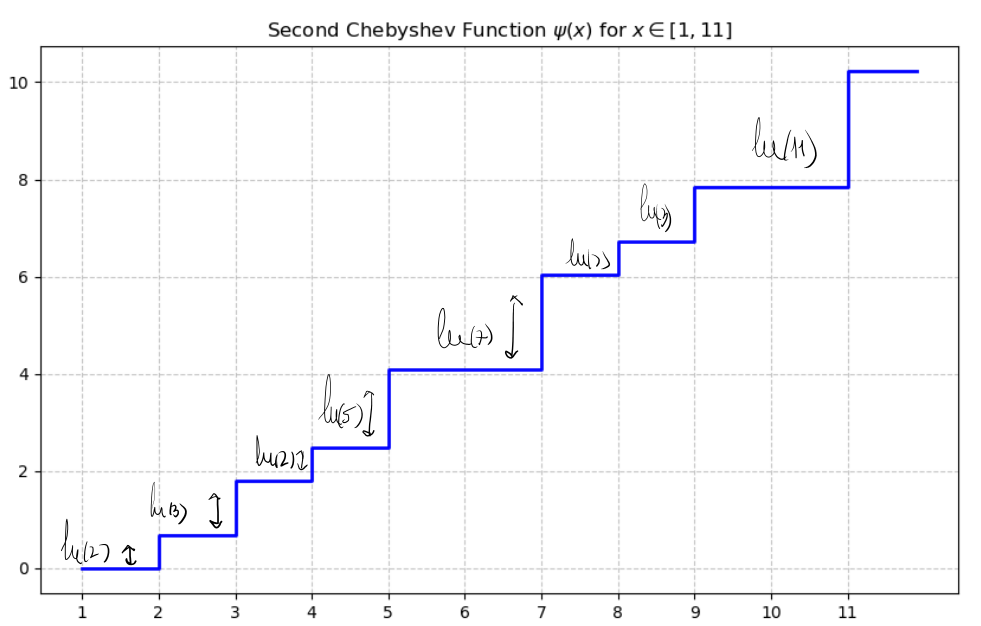
The second Chebyshev function, denoted by , is defined in terms of the von Mangoldt function:
where
This means that includes all prime powers, not just primes, but weights each one by .
Analyzing the expected increment when moving from to , the function increases by whenever hits a prime power .Primes (): Occur with density and contribute weight .$$\text{Expected increment} = \log x \cdot \frac{1}{\log x} = 1$$Squares (): A prime square means . The density of prime squares at is:$$\delta_2(x) = \frac{d}{dx}\pi(\sqrt{x}) \approx \frac{1}{2\sqrt{x}\log\sqrt{x}} = \frac{1}{\sqrt{x}\log x}$$Each prime square adds weight .$$\text{Expected increment} = \left(\frac{1}{2}\log x\right) \cdot \left(\frac{1}{\sqrt{x}\log x}\right) = \frac{1}{2\sqrt{x}}$$General -th powers: A power occurs with density and adds weight .$$\text{Expected increment} = \left(\frac{1}{k}\log x\right) \cdot \left(\frac{1}{x^{1 - 1/k}\log x}\right) = \frac{1}{k x^{1 - 1/k}}$$Summing the expected increments from all powers :$$\frac{d}{dx}\psi(x) \approx 1 + \frac{1}{2\sqrt{x}} + \frac{1}{3 x^{2/3}} + \dots$$Integrating this expected rate of change from to :$$\psi(x) \approx \int_1^x \left(1 + \frac{1}{2\sqrt{t}} + O\left(t^{-2/3}\right)\right) dt \approx x + \sqrt{x} + O(x^{1/3}) \approx x$$
Why Counts Prime Numbers
Although includes powers of primes (), those contribute very little compared to the primes themselves.
Most contributions to the sum come from , i.e., the actual primes.
Higher powers become rare as increases.
Every prime contributes to the sum via , and possibly a smaller number of contributions via .
So, behaves like a smoothed or weighted version of the prime counting function . While simply counts 1 for each prime , counts for each prime and its powers .
Why to use it?
It turns out that this function is more natural in complex analysis than the prime counting function or the first Chebyshev function above: see Riemann hypothesis, for the details.