Jacobi equation
Also known as geodesic deviation equation, it relates geodesics and Gaussian curvature.
This equation describes how the separation between geodesics (as measured by a Jacobi field) evolves as we move along the geodesics.
The equation is
with the notation given here.
In surfaces
In a 2-dimensional Riemannian manifold, the Riemann curvature tensor simplifies significantly. In particular, it can be expressed entirely in terms of the Gaussian curvature
where
So substituting this in the Jacobi equation we obtain
If the geodesic has a unitary tangent vector the equation simplifies to:
Intuitive approach of Needham
Case
In a surface
being
Proof
It uses geodesic polar coordinates. Also uses Gauss lemma.
By the way, it let us to show Minding's theorem.
Formal statement is based on the notion of Jacobi field.
Case
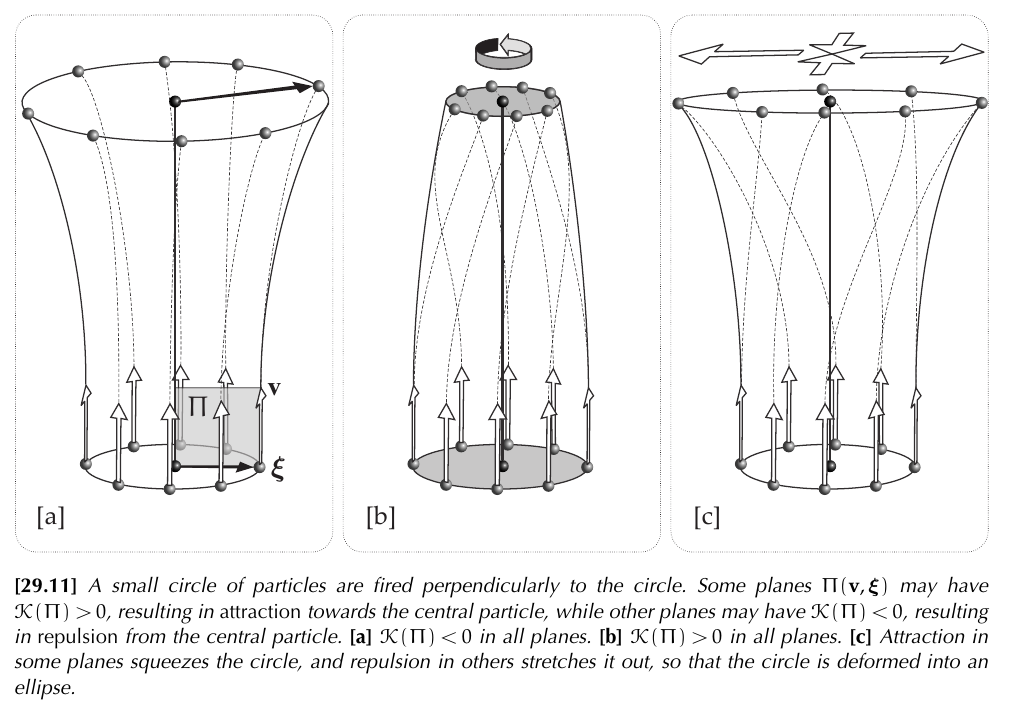
According to @needham2021visual there are two versions:
- Sectional Jacobi equation
where
- General Jacobi equation or Equation of Geodesic Deviation
When