Latticework
In the context of Spacetime Physics (Taylor and Wheeler), a latticework is equivalent to a "team of observers", and this construction represents a physical implementation of a coordinate system often used to interpret the mathematics of General Relativity (GR).
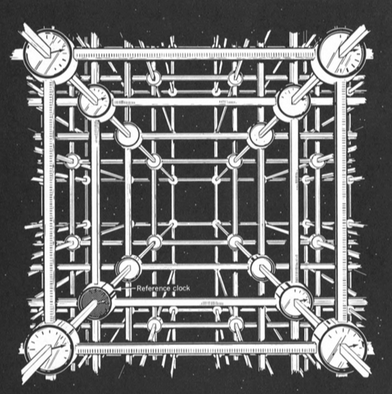
The Latticework as a "Team of Observers"
The book defines a latticework as a "work of the imagination" consisting of an assembly of clocks and meter sticks. In relativity, the term "observer" is specifically defined as a shorthand for the entire collection of recording clocks associated with one reference frame.
- Each clock in the lattice is viewed as a local witness that records events in its immediate vicinity.
- The set of these clocks forms a "team" or "congruence" where each individual clock follows a specific path (worldline) through spacetime.
- Holding the spatial coordinates
constant in the lattice effectively defines the path of one hypothetical observer in that team.
A Particular Case of coordinate systems in GR
A coordinate system is mathematically just a set of arbitrary labels with no inherent physical meaning. However, the "team of observers" (the latticework) is a particular case where coordinates are adapted to a physical perspective:
- The time coordinate (
) represents the labels on the synchronized clocks in the team. - The spatial coordinates (
) act as "comoving" labels that identify each specific observer within the team. - While any set of numbers can be a coordinate system, the latticework represents a "regimented" way to map those numbers to physical measurements like proper time and distance.