Length of a curve
In a pseudo-Riemannian manifold
Related: energy of a curve.
Interpretation
Length of a curve emerge from the following point of view.
Remember the definition, roughly speaking, of the Riemann integral:
See: Riemann integral.
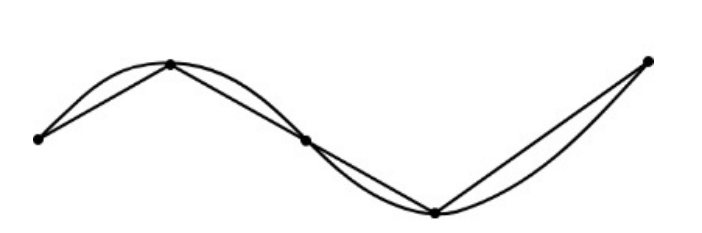
Now, if you want to calculate the length of a curve, you can cut it in little pieces. Suppose the curve is
Then, the length is, more or less,
where
But since
But this is, by definition
For a curve immersed in a general manifold we take local coordinates, and translate to the