We start with a proposition: Proposition
Let be a group, a normal subgroup and a subgroup. The following are equivalent:
There exists a group homomorphism such that and
It is satisfied that and
When any of those requirements is satisfied we write
Definition
When we have the context given by condition 1 or 2 we say that is the semidirect product of and and we write .
Remarks
The "converse" is not true. Given a normal subgroup of , is not necessarily the semidirect product of and . For example: which contains . I have to think it.
Another characterization. An exact sequence to be isomorphic to one of the form is if has a section.
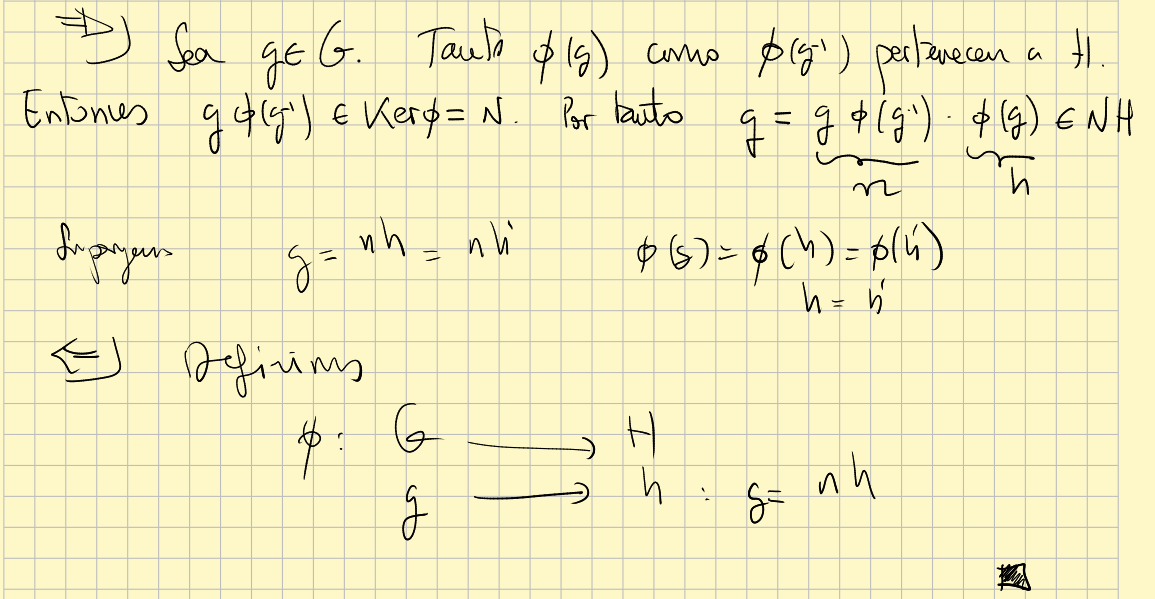
Under condition 2 every can be written in an unique way as a product , . If then and therefore
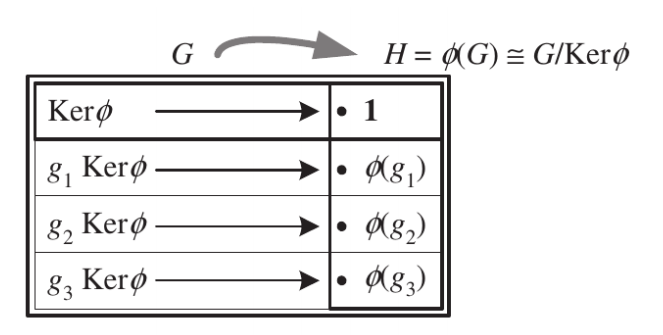
Condition 1 is like saying that the main group can be seen like a bundle, since we have a idempotent map . The standard fibre is .
Image from Mathematics for Physics, an ilustrated handbook, page 40.
Proof
The product in
The product in takes a special form: given and then and
therefore
We can think in as translations and as rotations.
Key example
Suppose the group of isometries of the euclidean plane, or rigid motions. It is known that any element of can be seen as the composition of a translation (an element of ) and a linear isometry (an element of , that is, a rotation with centre at the origin or a reflection with axis through the origin). This decomposition is unique.
Moreover, translations are a normal subgroup of : you can see it intuitively "moving things on a table" or by computation:
Therefore
In general, if we now consider any subgroup of we can consider the subgroup of
It is easy to show that is isomorphic to (construct the map of the definition).
Conversely, given any group , with and , it can be shown that is isomorphic to a subgroup of of this form. Consider
and
Now it is easy to see that is isomorphic to a subgroup of with the form above by means of the map:
This map is a homomorphism. The product in takes the form
and with a standard computation can be checked that
Moreover, the map is also injective, as it is easy to check.
Another approach
Within this approach we can create a group being the semidirect product of two given groups.
Definition. Let and be groups, and let be a group homomorphism such that defines a group action of on . The semidirect product is the Cartesian product endowed with the multiplication operation
where denotes the action of on .
It can be shown that it is indeed a group.
About the Lie algebras
I think it can be proven the following proposition Proposition
Let be a Lie group that is the semidirect product of a normal subgroup and a subgroup , i.e., . Then the Lie algebra of has a canonical decomposition as an -module given by
where and are the Lie algebras of the subgroups and , respectively.
Proof
The idea is:
Show that as vector spaces
is an -module, and of course . But also, since is normal, we have that