A vector space together with a non-degenerate alternating form
The alternating form plays the role of pairing the coordinates of the space. The canonical example is with coordinates and
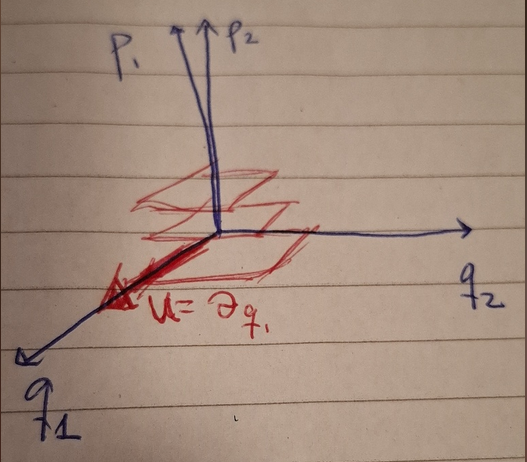
so that each is paired with its , and the space splits into the distinguished planes .
From a vector to a covector. Fix . The map
is linear, so it is a covector. Its kernel is a hyperplane of (equivalently, its level sets are a family of parallel hyperplanes, the picture of a covector in visualization of k-forms). This way, to each vector the form associates a hyperplane, and therefore a covector. Since is non-degenerate, a nonzero vector gives a nonzero covector, and the correspondence is an isomorphism , similar to the musical isomorphism in dual vector spaces.
Intuition.
The form is a device that measures parallelograms: given , the number is computed by projecting the parallelogram spanned by and onto each of the distinguished planes and adding up the (signed) areas of these projections. This is the measurement picture of visualization of k-forms.
When we fix a vector , vectors s such that are those who after projection of and , are proportional to . In the canonical example above, if , the s are precisely all the ones whose component in is zero.