Torsion
Definition
Given a manifold with a linear connection,
Or, in Penrose abstract index notation:
Interpretation
Since we know that the Lie bracket
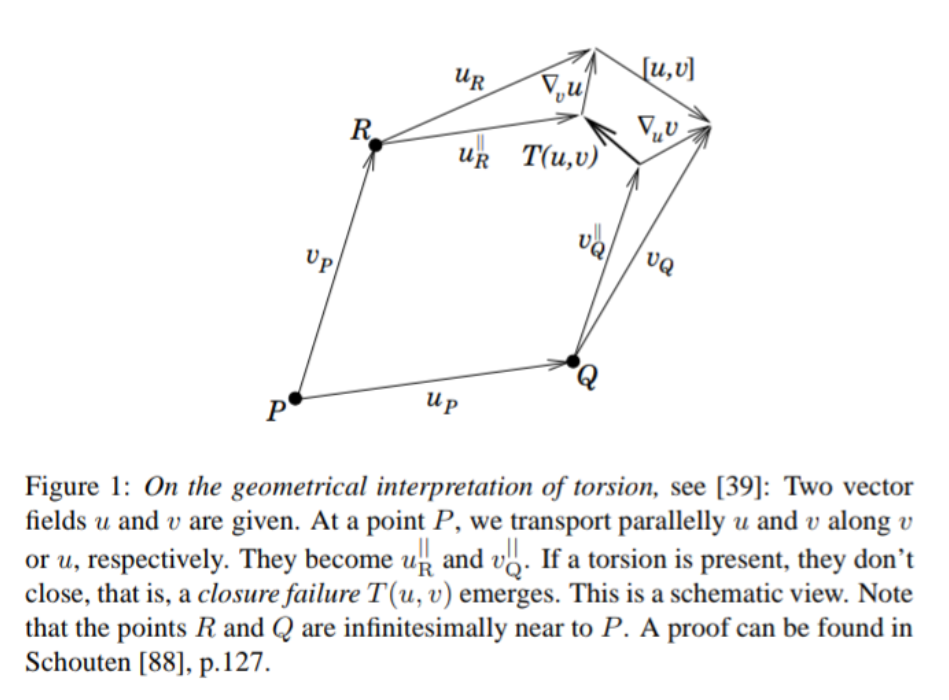
Personal thought: I think it should be defined independently of the Lie bracket, in a way that reflects more intrinsically the idea of "the fail to close a rectangle made of parallel transported vectors along the flow".
Explanation (see better relation of Lie derivative, covariant derivative and torsion): observe that, as it has been said here,
and so
In the (schematic) picture above, since
And analogously
On the other hand, observe that according to this, we have
and therefore the quantity
which is the gap of the parallelogram made of parallel transported vectors (along infinitesimally short curves
Almost always, the given connection is torsion free (for example, the Levi-Civita connection). So it turns out that
Expression in coordinates
It can be shown that for any connection, in coordinates,
i.e., the difference of the Christoffel symbols, in case it is the Levi-Civita connection.
Since it is a torsion free connection, Christoffel symbols are symmetric.