The Andromeda Paradox (Roger Penrose)
The Andromeda Paradox is a thought experiment in special relativity, popularized by the physicist Roger Penrose. It vividly illustrates the concept of the relativity of simultaneity and how it leads to counter-intuitive conclusions over vast cosmic distances.
The core idea is that the "present moment" or "now" is not universal. Two observers having a nonzero relative velocity will disagree on which distant events are simultaneous with the moment they pass each other.
The Setup
Consider two people, A and B, on Earth. They are walking slowly past each other in opposite directions.
- Observer A is walking in the direction of the Andromeda Galaxy.
- Observer B is walking away from the Andromeda Galaxy.
- The Andromeda Galaxy is approximately 2.5 million light-years from Earth.
Even though their relative speed is exceedingly small (a casual walking pace), this tiny difference in velocity, when magnified by the enormous distance to Andromeda, results in a significant discrepancy in what they consider to be happening "now" in that distant galaxy.
The diagram below illustrates this situation (from Penrose, Emperor's new mind)
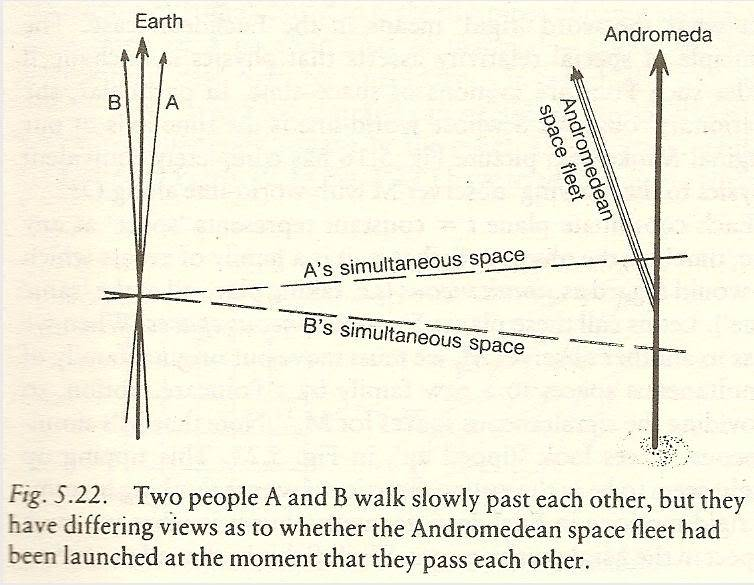
In this spacetime diagram:
- The vertical axes represent time, and the horizontal direction represents space.
- The nearly vertical lines labeled Earth represent the "worldlines" of the observers A and B. They are tilted slightly relative to each other, indicating their relative motion.
- The lines labeled "A's simultaneous space" and "B's simultaneous space" represent the "plane of simultaneity" for each observer. This is the slice of spacetime that constitutes their "now" at the moment they pass each other.
The Paradox Explained
Due to the effects of Special Relativity, an observer moving towards a distant object will have their plane of simultaneity tilted towards that object's future. Conversely, an observer moving away will have their plane tilted towards the object's past.
As shown in the figure:
-
For Observer A (walking towards Andromeda): Their "simultaneous space" line is tilted upwards. At the moment they pass B on Earth, their "now" in Andromeda intersects the worldline of the Andromedean space fleet after it has been launched. To A, the fleet is already on its way.
-
For Observer B (walking away from Andromeda): Their "simultaneous space" line is tilted downwards. At that same moment on Earth, their "now" in Andromeda intersects the fleet's worldline before the launch. To B, the decision to launch might not even have been made yet.
The "paradox" is that two people, momentarily at the same place on Earth, can have such radically different "present moments" in Andromeda—differing potentially by days or even weeks—just because they are walking in opposite directions.
Implications
Roger Penrose used this example to argue for the "block universe" concept. If one observer's "future" is another observer's "past," it suggests that past, present, and future events are all equally real and already exist in a four-dimensional spacetime "block." There is no single, universal "flowing" time that applies to the entire universe.