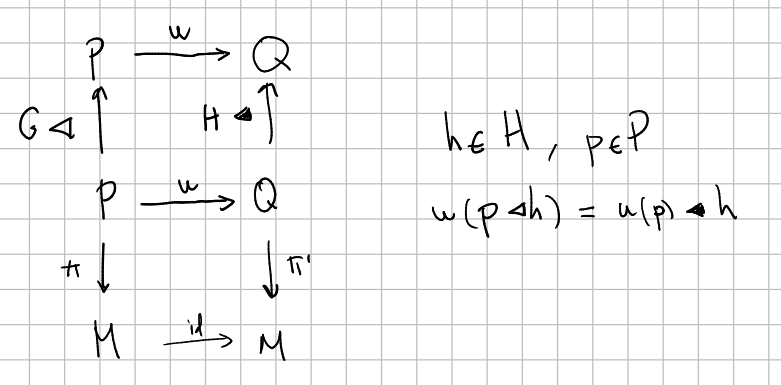
In the setting of principal bundle morphism, a reduction of the structure group of a principal bundle over a base space with structure group is what follows. Suppose is a subgroup of , and let denote the inclusion map. A reduction of the structure group from to refers to the existence of a principal -bundle and a principal bundle morphism, , i.e.:
The diagram
commutes, meaning .
2. The -equivariance condition for is satisfied:
where as is a subgroup of .
Extension and restriction of a principal bundle from [Schuller 2013]
Definition
([Schuller 2013] page 178. There are some gaps in the definition and in the theorem, I think. On the other hand, I think this can be also calle group reduction or group structure reduction.)
Let be a closed subgroup of . Let a principal -bundle and a principal -bundle. If there exists a principal bundle morphism from to , i.e. a smooth bundle map which is equivariant with respect to the inclusion then is called an -restriction of and is called a -extension of .
Theorem
[Schuller 2013] page 178.
Let be a closed Lie subgroup of .
i) Any principal -bundle can be extended to a principal -bundle.
ii) A principal -bundle can be restricted to a principal -bundle if and only if the bundle has a section. Proof
I don't know.