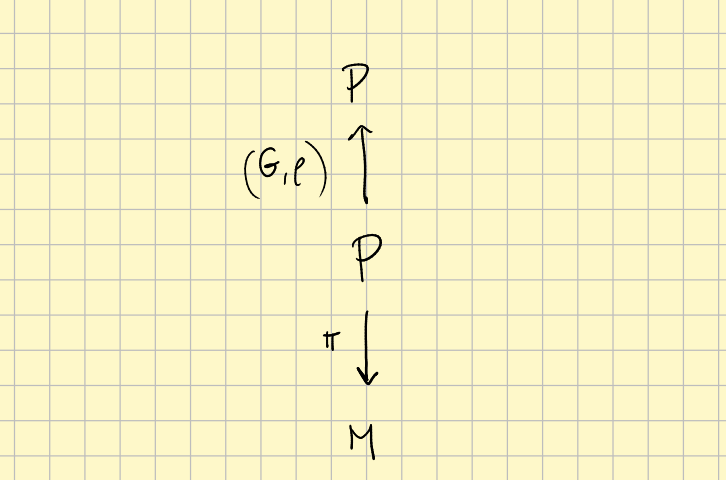
We come from the context G-bundles.
Given a G-bundle we will call it a principal -bundle if the standard fibre is and there exists a free right action of on such that
The orbits of are the fibres of .
For every local trivialization
we have that for every and
Observe that this is equivalent to saying that we have a fibrewise right action of over that is free and transitive over each fibre. Each fibre is, then, a G-torsor. We will use indistinctly the notations when needed for clarity.
We will write
Infinitesimal behavior of the right action
Let be a right principal -bundle over a smooth manifold , and let be the projection map. Let denote the right action of the group on , defined by for and .
We consider the differential of the projection map, denoted , which is a linear map between the tangent spaces at corresponding points. Moreover, let be the pushforward (differential) of .
The behavior of with respect to is characterized by the following commutative diagram:
This means that for each , the following equation holds:
In a specific point
This commutative property encapsulates the equivariance of under the right -action and indicates that the differential is essentially "constant" along the -orbits in .
Alternative approach
Given a G-bundle with standard fibre , the associated principal -bundle is, in a sense, a generalized frame bundle for the original bundle. To see this, observe that the principal -bundle can be obtained in the following way. Given a trivializing atlas of , we can define for every the set
Their elements are the different ways of express the fibre (maybe an "uncomfortable" space) in terms of the standard fibre (a "comfortable space), "preserving" the structure provided by . We can call them the -bases for (when is a vector space, is and the set is made of the different basis of . See the note basis and change of basis).
Observe that for it could happen
and then must be
So if we consider the space
we can provide maps
such that it can be proven that is a principal -bundle with atlas .
(It can be proven with the final topology and the fact of being a Lie group...)
Components of a section
Thus, given a G-bundle and its associated principal -bundle constructed in this way, we can define the components of with respect to any :
Then, any local section of can be called a -frame, and therefore every local trivialization is equivalent to a distinguished -frame, the one defined by:
and being the identity in .
In some context they are called moving frames or choice of a gauge. In case that the G-bundle is the tangent bundle of the manifold, the concept of -frame is the usual frame.
Trivializations vs sections
The orbit of at is just the fiber and, moreover, . We can imagine like but without a distinguished point . For example, a circle bundle () has a fiber which could be rotated but no point is matched with the identity. That is, every fiber is a -torsor or principal homogeneous space.