Exterior derivative
See Wikipedia
Coming from differential forms.
It is an antiderivation of degree 1 on the exterior algebra.
- For a 0-form
is the differential of for 0-forms (for the other differential forms can be deduced) where is a -form.
To make this notion intuitive, we could use the following rough definition:
Definition. Given a
where
A 1-form in
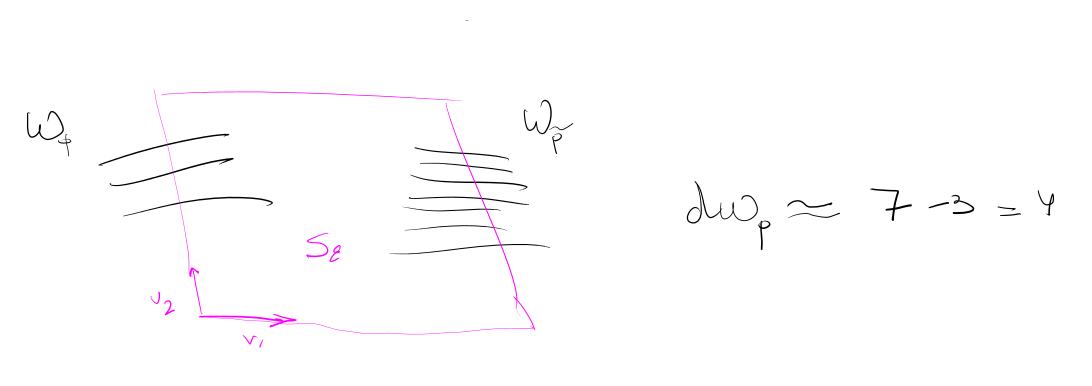
Another example: there is no misalignment
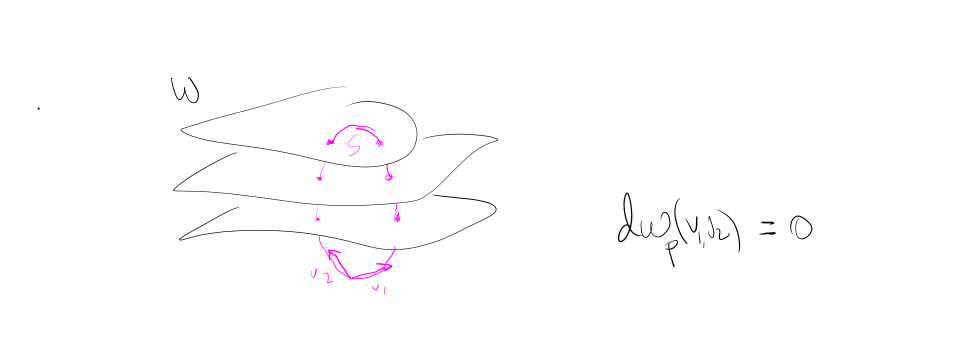
A different case: a 1-form in
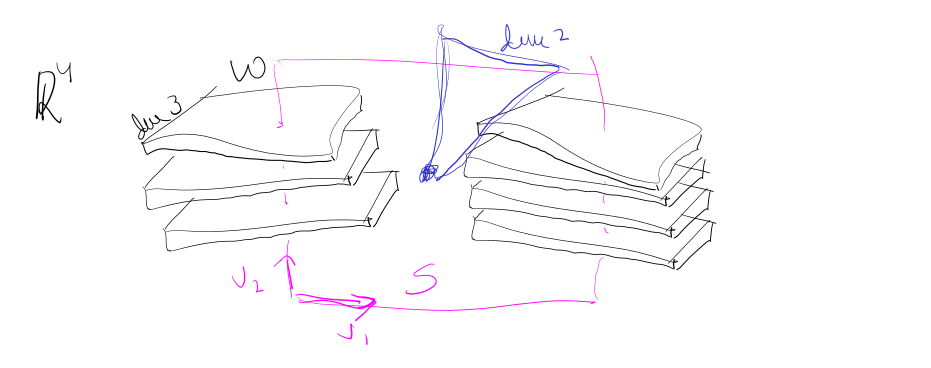
For visualization of planes, hyperplanes and lines in
Visualization 1
See xournal 284
Visualize
The Golden Rule: The lines/tubes of the 2-form
are precisely the edges or vortex lines such that the number of tubes crossing a parallepiped generated by vectors is the same as the net sum of crossing numbers of the path through the local sheets defined by in nearby points (to guarantee Stokes' theorem).
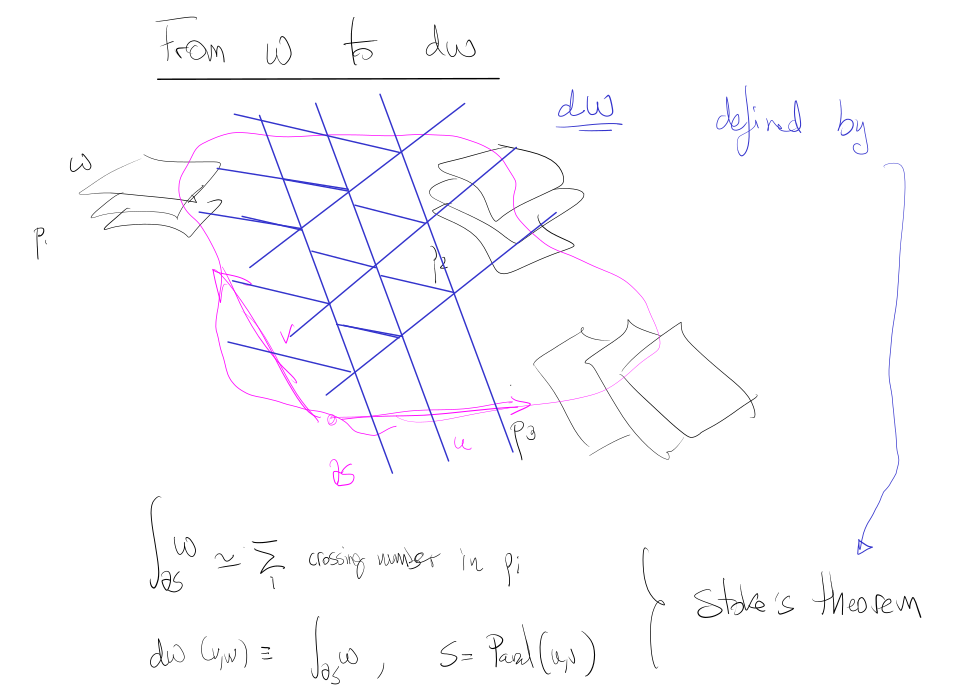
These edges are located where the local sheets of
We can distinguish three cases:
1. Closed 1-form,
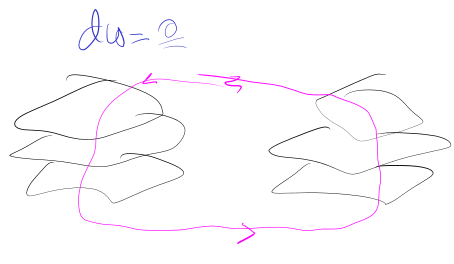
We can glue the planes given by
**2. Frobenius integrable 1-form,
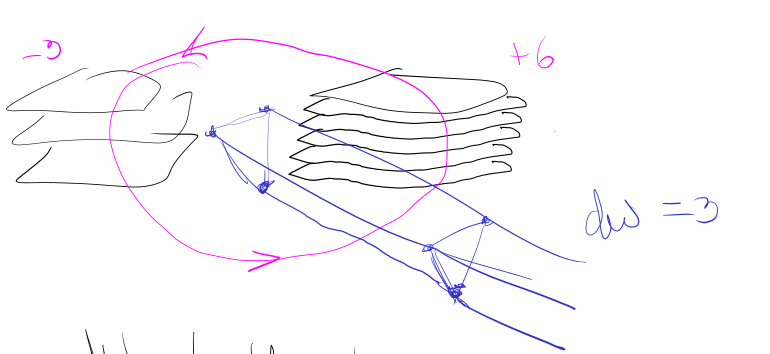
When
3. Non integrable,
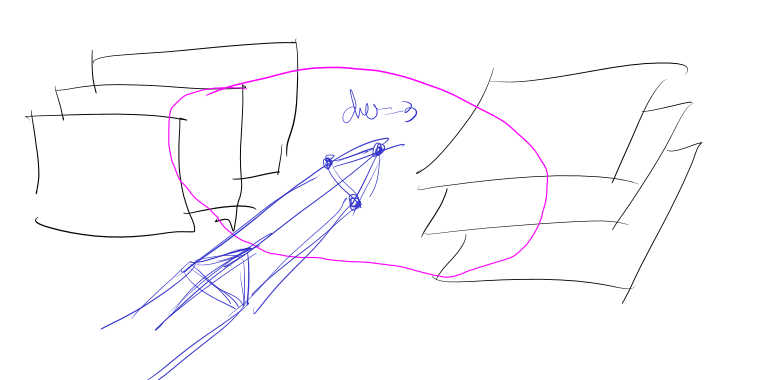
Suppose that when we displace ourselves to the right, the planes
1. The "onion" example,
Consider the foliation of spheres
It may be given, instead of by the obvious closed 1-form, by the Frobenius integrable 1-form
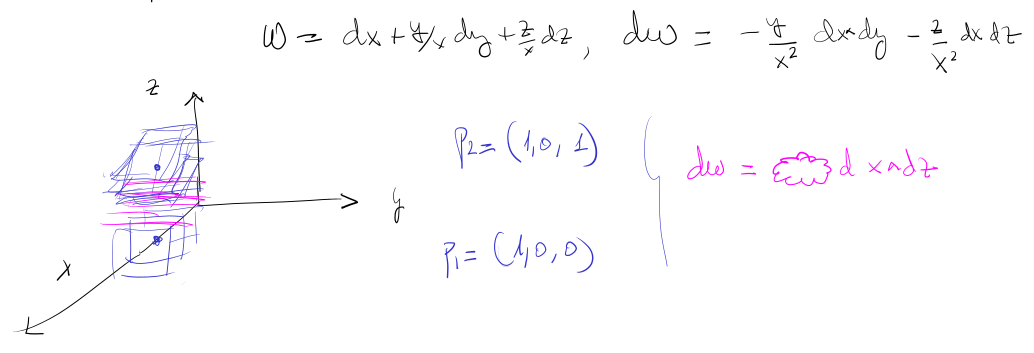
The 2-form
2. The "Extra Pages" Example:
Let's look at a classic non-closed 1-form to see how this works.
The sheets where
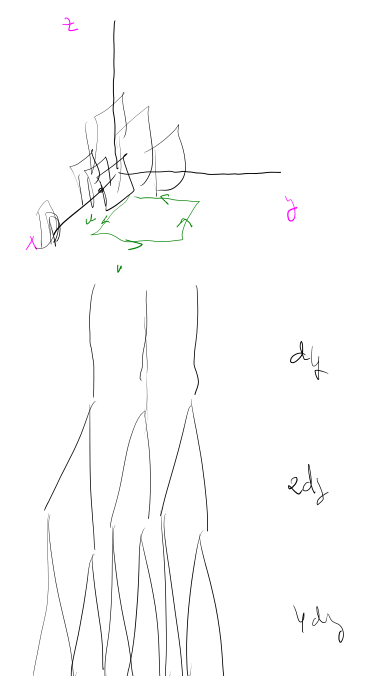
Imagine drawing a square loop in the
- Top and Bottom edges (
): We are walking parallel to the sheets, so we pierce 0 sheets. - Left edge (
): We walk downward from to . Since the density is lower here, let's say we cross 10 sheets in the negative direction. - Right edge (
): We walk upward from to . Because is larger, the sheets are twice as dense here! We cross 20 sheets in the positive direction.
Our net sheets pierced around the loop is
The only logical explanation is that 10 new sheets must have started (originated) inside your square loop. They didn't extend all the way to the left; they popped into existence as the density increased.
Since these extra sheets are 2D surfaces in 3D space, their originating "edges" must be 1D lines. Because the density changes uniformly with
If you calculate the exterior derivative algebraically, you get:
This 2-form represents a uniform grid of lines pointing in the
A non integrable example
Consider the contact form
See also: visualization of integrability of a Pfaffian system
Visualization 2
See also: visualization of k-forms.
Exterior derivative must be called the negative accumulation meter or production meter.
Case 1: 0-Forms
For a 0-form
Example (1D water pipe with a source):
Consider a pipe (
- Let
be the total flow passing point . - For
, (no water yet). - For
, (water added by the source).
- For
- The exterior derivative
is a 1-form encoding the source:
where
- Interpretation:
where no sources exist (since is constant). - At
, spikes to reflect the production of 4 units.
- Integration:
confirming the source’s contribution.
General Intuition:
measures the net change of along , for infinitesimally close. - If
, is conserved (no production/loss) along that direction.
Case 2: 1-forms
In the case of a 1-form
In a sense, the value of
Case 3: 2-forms and more
In the case of 2-forms, for example in
If we apply the exterior derivative of the 2-form to a volume element (a 3-vector), we get something completely analogous to what was described above: pulling back to that "infinitesimally small 3-dimensional space," the 2-form still appears as a kind of one-dimensional flow, and its differential tells us how much is being generated inside (what goes out minus what came in).
If instead of working in
Why
From here it shouldn't be difficult understand why
For 0-forms it is easy: if
For a 1-form is the same, but a bit more difficult to visualize. In this case
The interpretation of