Hodge star

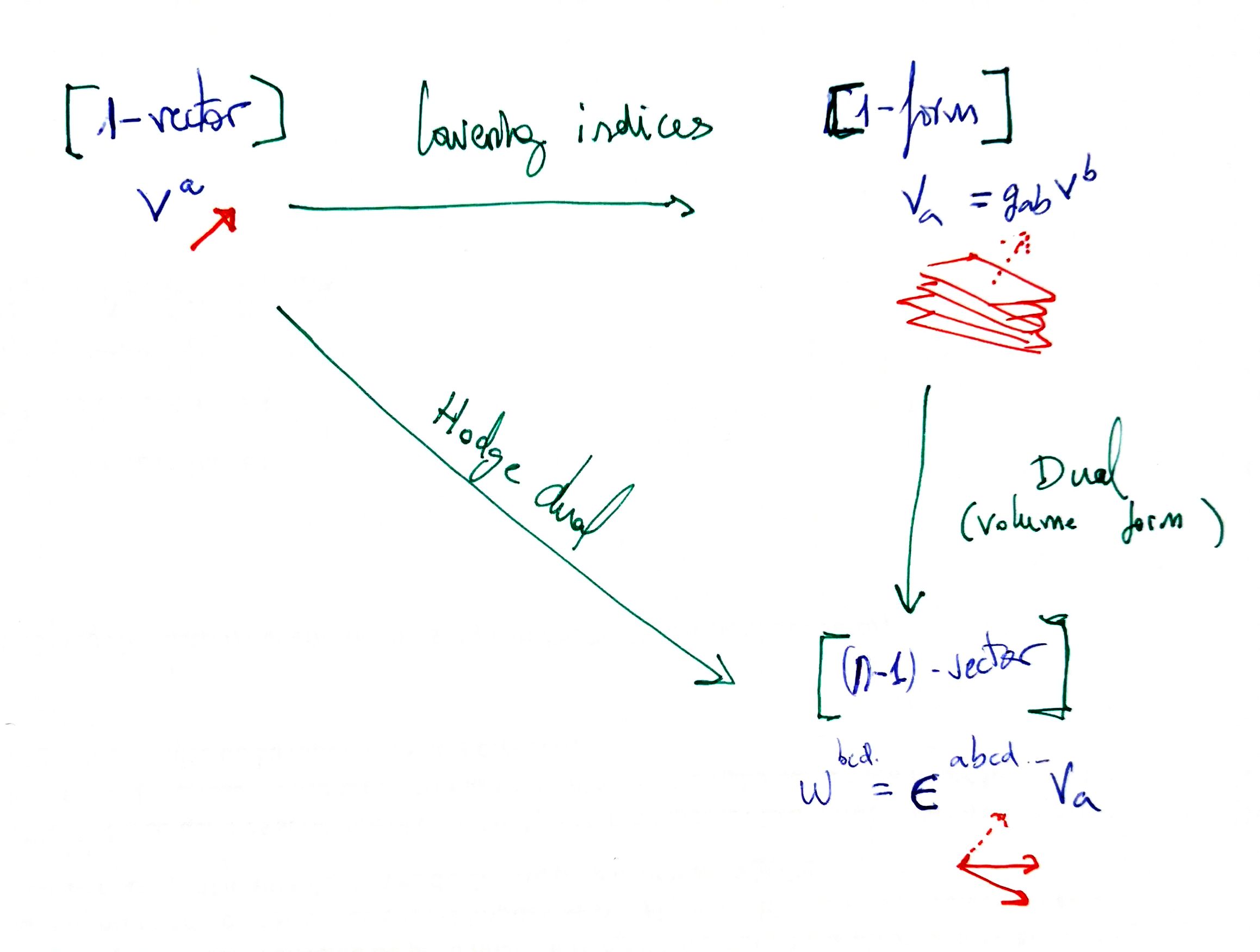
As explained in duality in exterior algebras, if we have a fixed volume form, for a simple k-vector w we have the (n−k)-form

w↦vol(w,−)

Reciprocally, to every k-form we can associate a (n−k)-vector at this way.

In the presence of a metric, we can make use of this duality and then apply the musical isomorphism (raising and lowering indices). This is the Hodge star:
hodgedual_2.jpg|500

It turns out that given an isometry f:M→N of Riemannian manifolds, then the Hodge star commutes with the pullback f∗ of forms.

Alternative definition

The Hodge star operator in R4 with a pseudo-Riemannian metric maps a p-form β to a (4−p)-form ∗β, defined by:

α∧(∗β)=⟨α,β⟩vol

where vol is the volume form, and ⟨α,β⟩ is the metric-induced inner product on forms (see @baez1994gauge page 88).

In an orthonormal frame

Exercise 69 in @baez1994gauge
Let M be an oriented semi-Riemannian manifold of dimension n and signature (s,n−s). Let eμ be an orthonormal basis of 1-forms on some chart. Define the Levi-Civita symbol for 1≤ij≤n by

ϵi1…in={sign(i1,…,in)all ij distinct0otherwise.

Show that for any p-form

ω=1p!ωi1…ipei1∧⋯∧eip,

if

⋆ω=1p!(⋆ω)j1…jn−pej1∧⋯∧ejn−p

we have

(⋆ω)j1…jn−p=ϵj1…jn−pi1…ipωi1…ip.

In coordinates

From here.
Let X be a pseudo-Riemannian manifold of dimension D and metric g, and locally, on some open set U⊂X, let

e1,…,eD∈Ω1(U)

be a coframe. For example, if {xi} is a coordinate chart on U, then ei:=dxi can be such a coframe.

With this choice, any differential form α∈Ωp(U) has a component expansion

α=1p!αi1…ipei1∧⋯∧eip

where here and in the following we use the Einstein index notation.

In terms of these components, the Hodge dual ⋆α of α is expressed by the following formula:

⋆α=1p!(D−p)!|det((gij))|αj1…jpgj1i1⋯gjpipϵi1…ipip+1⋯iDeip+1∧⋯∧eiD=1p!(D−p)!|det((gij))|αi1…ipϵi1…ipip+1⋯iDeip+1∧⋯∧eiD

Examples

R3 standard metric

The formula for the Hodge star operator might seem complicated, so consider an example. Take dx,dy,dz as a basis of 1-forms on R3 with its usual Euclidean metric and orientation. Then we have

⋆dx=dy∧dz,⋆dy=dz∧dx,⋆dz=dx∧dy,

and conversely

⋆(dx∧dy)=dz,⋆(dy∧dz)=dx,⋆(dz∧dx)=dy.

R3 with general metric

Another example, given a 1-form ω=ωadxa in R3 with a Riemannian metric gab, ⋆ω is a 2-form with components given by:

(⋆ω)ab=12ϵabcgdcωd|g|

where ϵabc is the Levi-Civita symbol and |g| is the square root of the determinant of the metric tensor.

On the contrary, for a 2-form ω=ωabdxa∧dxb we have

(⋆ω)c=12ϵcabωab|g|

where ωab=gacgbdωcd.

M4, Minkowski space

For one-forms, the Hodge star operator ⋆ acts as follows:

⋆dt=−dx∧dy∧dz,⋆dx=−dt∧dy∧dz,⋆dy=−dt∧dz∧dx,⋆dz=−dt∧dx∧dy.

For 2-forms, ⋆ acts as:

⋆(dt∧dx)=−dy∧dz,⋆(dt∧dy)=−dz∧dx,⋆(dt∧dz)=−dx∧dy,⋆(dx∧dy)=dt∧dz,⋆(dz∧dx)=dt∧dy,⋆(dy∧dz)=dt∧dx.

These results can be summarized in index notation as:

⋆(dxμ)=ημλϵλνρσ13!dxν∧dxρ∧dxσ,⋆(dxμ∧dxν)=ημκηνλϵκλρσ12!dxρ∧dxσ.

R2 with Lorentzian metric, i.e., M2

Consider R2 with the metric dt2−dx2. The volume form on this spacetime is given by:

vol=|detg|dt∧dx=dt∧dx,

since |detg|=1 for the metric diag(1,−1).
For a 2-dimensional spacetime, a 2-form is mapped to a 0-form under the Hodge star operator. The relationship is:

α∧⋆α=(α,α)vol,

where (α,α) is the inner product induced by the metric. For dt∧dx, the inner product (dt∧dx,dt∧dx) is computed using the determinant of the metric restricted to the directions of the 2-form.
In our case, the metric determinant is −1, so:

(dt∧dx,dt∧dx)=−1.

Therefore:

⋆(dt∧dx)=−1.

Similarly:

⋆dt=dx,⋆dx=−dt.