Coframe

It is dual to frame on a manifold.
It is an ordered set of 1-forms {θ1,…,θm} defined on an open set U of an m-dimensional manifold M such that they span the cotangent space TxM for every x∈U.

An ordered set {θ1,…,θm} define a coframe if and only if

θ1∧…∧θm≠0

for every x∈U ([Olver_1995]).

A global coframe provides, therefore, an orientation and a trivialization o T∗M≈M×Rm, so it is also called absolute parallelism.

Generation of k-forms

A coframe {θ1,…,θm} does not only generate any 1-form, but also any differential k-form can be written as linear combination of k-fold wedge products:

∑IhI(x)θi1∧⋯∧θik

See [Olver_1995] page 254.

Duality with frames

A frame on a manifold and a coframe are dual if they are dual basis for every x∈U. Given a coframe, the dual frame will be denoted by

∂∂θj

Given coordinates (x1…,xm) on the manifold, we have distinguished local frame and coframe denoted respectively by
{∂∂x1,…,∂∂xm}

and

{dx1,…,dxm}.

Example of computation in this coframe: Lie derivative of a 1-form in the canonical coframe.

Given a coframe {θ1,…,θm} any k-form Ω can be written as a linear combination

Ω=∑IhI(x)θi1∧⋯∧θik.

In particular,

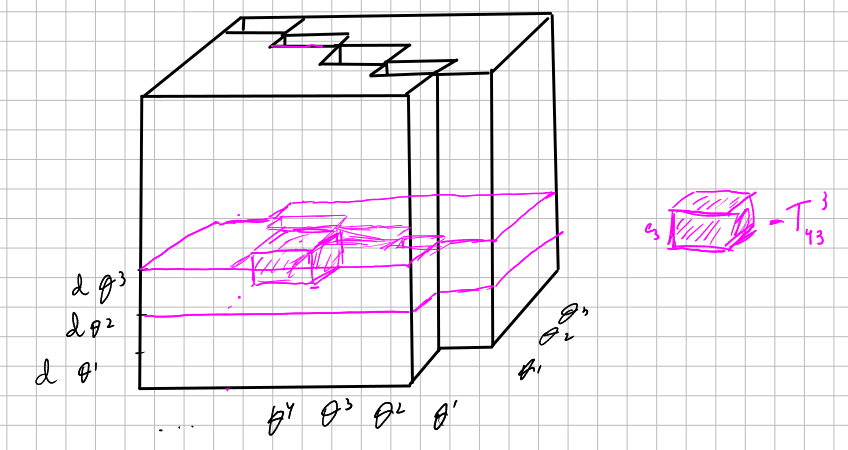
dθi=∑j,k=1j<kmTjkiθj∧θk

expressions which are called structure equations of the coframe and Tjki are called structure coefficients. They are also called Maurer-Cartan equations when we are dealing with a left-invariant coframe on a Lie group. See Maurer-Cartan form#Structural equation/MC equation.

These equations are the dual version of

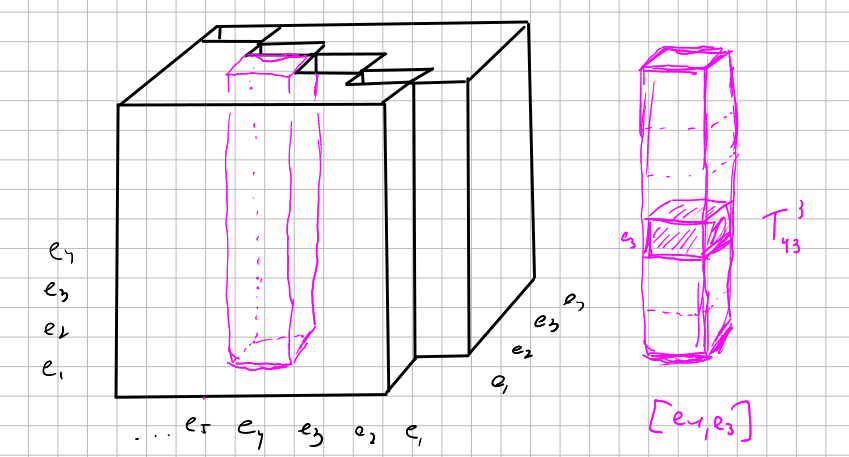
[∂∂θj,∂∂θk]=−∑i=1mTjki∂∂θi

([Olver 1995]). This relation is proved by the infinitesimal Stokes' theorem.

Visualization

(where we are calling ej to ∂∂θj):
Pasted image 20211226092246.png

Pasted image 20211226092359.png