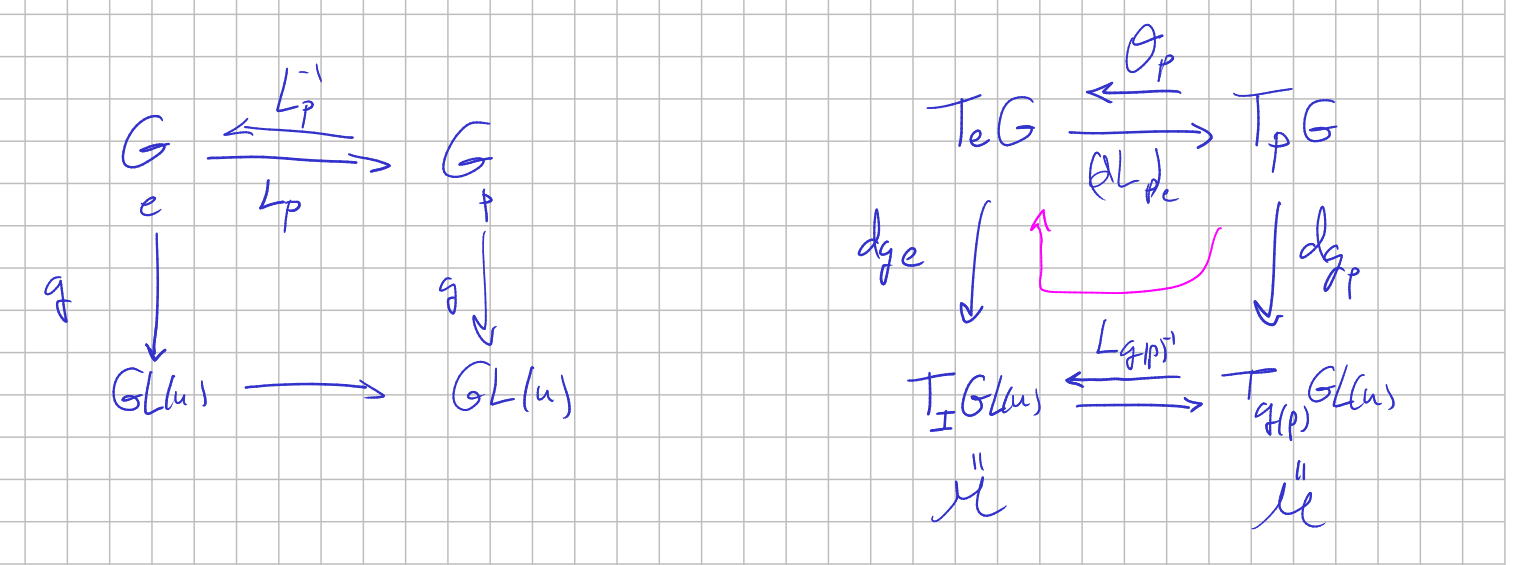
In case is a matrix Lie group, i.e., then the (left-invariant) Maurer-Cartan form can be computed with the following formula
This is the expression appearing everywhere, but I think the correct expression for should be, for and
But what is ? Following @ivey2016cartan definition 1.6.1, is a parametrization (embedding) of the group as a submanifold of but the name is a bit misleading. For example, consider for the embedding
given by . The differential is a map
and we know that for a vector the image is computed as
If we use the natural identification we can think of as the -valued differential 1-form
In the case of , think in as the parameter space and a fancy way of writing . So is a -valued differential form in . This way, the expression is also a -valued differential form in .
Examples
I have worked examples in xournal 188 (affine group) and xournal 189 (Euclidean group).
Interpretation
In xournal 189 there is a reflection on how do we understand the Maurer-Cartan form when the group is interpreted as a set of frames. If is the set of frames or -descriptions of a homogeneous space (see this), then for a frame , a vector can be thought as an arrow connecting the frame with a "nearby" frame , i.e., something like . That is, is a infinitesimal change of the frame . In this context, is nothing but how this infinitesimal change can be described from the own frame .
The same in other words (following ideas of the end of this): given a frame , we can consider a nearby frame . To express this "frame" in the frame we take
So the Maurer-Cartan form is the "infinitesimal displacement" of the frame, but described from the point of view of the chosen frame.