A real-valued function is a first integral of the Pfaffian system if . That is,
or equivalently,
Alternatively, if is the annihilator of , then is a first integral of if for all vector fields . These conditions translate into a system of homogeneous first-order linear PDEs for .
There is also a purely differential-algebraic meaning to counting the number of functionally independent first integrals for . Let
be the derived flag of . Then the terminal derived system (the system at which the flag stabilizes) is a Frobenius system, and the number of first integrals of equals the rank of .
Observe that the characterization let us try to find the first integral without looking for the integrating factor.
1.b. First integral of an EDS
For a general EDS a function is a first integral if
Unlike §1, the system need not be a Pfaffian system: it can be generated by forms of higher degree. And unlike an ODE, is now generally a surface, or a higher-dimensional manifold, rather than a curve. For a two-variable PDE, means that is constant with respect to both and along the solution: a considerably stronger statement than ordinary conservation in time. See conservation law and first integral vs conservation law.
2. First integral of a vector field
is a first integral of a vector field if . For polynomial vector fields, the Darboux method constructs first integrals from invariant algebraic curves. The meaning is that the flow of is contained in hypersurfaces .
Observe that a first integral of the vector field is a solution of the PDE
Equivalence with 3.a.
This definition is equivalent to the previous one, since if then
and so
And conversely, if
and therefore and so
Relation to definition 1 above
The ODE can be though as the 1-form
In order 1, this 1-form is the only thing we have regarding the ODE, there is no more information. In higher order we have more data: the Cartan distribution. With this preliminaries we can assure:
Proposition
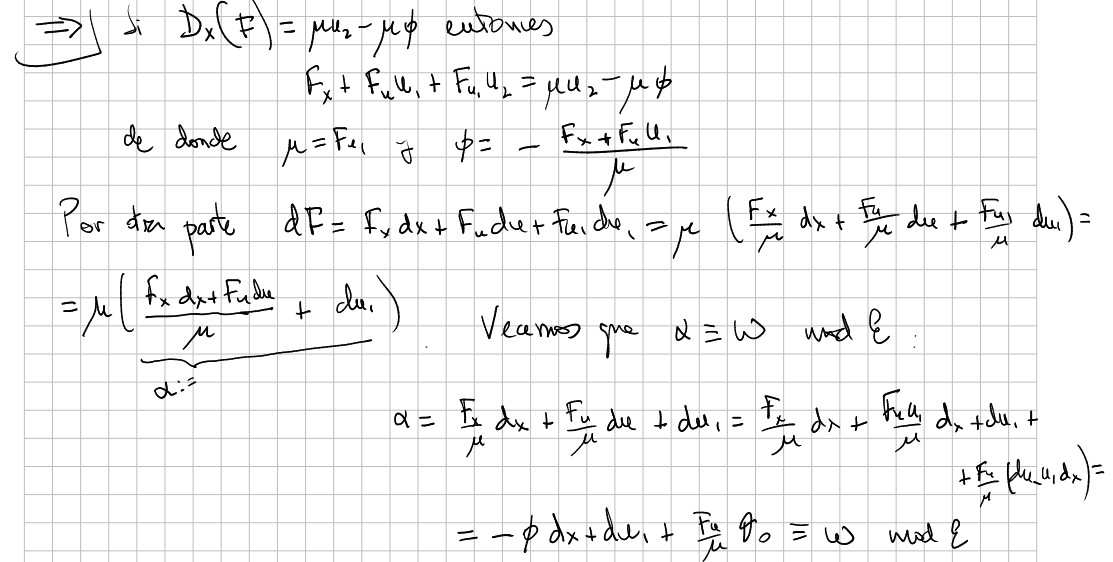
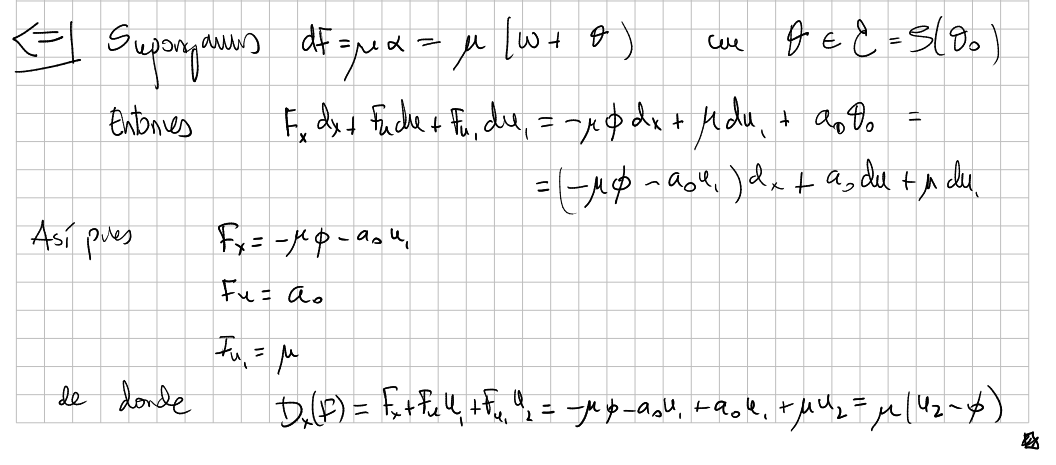
There exist a pair such that if and only if for certain 1-form mod , i.e. .
This result can be stated for any order . Proof
[xournal 126]
4. First integral of a distribution
Given a distribution on a manifold , a function is called a first integral of if every integral submanifold of is contained in a level surface of , or equivalently if for any . It is coherent with this definition.