Riemannian metric for an ODE
Index of related atomic notes:
- Riemannian metric for a first-order ODE — Construction for
- Riemannian metric for an autonomous second-order ODE — Construction for
- Gauss curvature of an ODE-surface — Curvature formula
- flatness-integrability theorem — Flat ⇔ quadratures
- surface deformation of ODEs — Deformation family
- energy foliation — Minimal foliation for 2nd-order ODEs
Original ideas (obsolete)
(Está obsoleta, revisar para ver cómo encaja con lo nuevo y luego borrar)
Cuando hacemos el cambio de variable
estamos transmitiendo la métrica usual de
¿Podrían tener utilidad estas ideas?
Tendría algo que ver aquí el Ricci curvature tensor? (las soluciones de la ODE son geodesics con la métrica inducida...)
Más de lo mismo: en el caso de orden 1, por ejemplo, tendríamos un
Se pueden caracterizar estas métricas? Las métricas son una sección de un fibrado, estas métricas son un tipo especial?...
Más ideas. El conocimiento de las integrales primeras de la ecuación es equivalente al conocimiento de la métrica, pues con ellas podría rectificar el campo y obtener el cambio de variable como el de arriba.
¿Los vectores normales de las hipersuperficies integrales primera son los que rellenarían la base ortonormal que comienza con A? En realidad no, lo serían los normales a ellas pero con la "nueva" métrica... Necesitaría vectores que sean symmetry of a distribution de esas integrales primera... y que además formen el ángulo adecuado.
On the other hand, there are lots of metrics with these requirements. I don't need
Hacer experimento con la ecuación de un péndulo doble, cuyo espacio de configuración es un toro, o el péndulo simple,... para ver si hay alguna relación entre la métrica asociada (la conocemos, pues sabemos la solución general) y la métrica del espacio "en el que viven"
Ideas para paper
Ver xournal_123 page 6, and maple_022.
Nuevo enfoque
See Maple_035 and xournal_139.
If we want to find the integral curves of a vector field, for example the vector field
A way to perform this "correction" is by measuring the separation using the area (the standard volume form) and dividing by the length of the vector (computed with the standard Riemannian metric). But this only will work for special cases in which the desired integral curves are parallel curves with respect to the standard metric.
But what if this is just the case for every ODE, with the only trick that we have to consider a different metric? The Riemannian metric associated to the equation could be conformal to the standard one (in isothermal coordinates):
with
where the ODE is given by
I think that for general vector fields
where
Observe that in the new metric
which of course is closed.
I think that the quotient
Relationship with symmetries
Suppose that
How does it fit in this context?
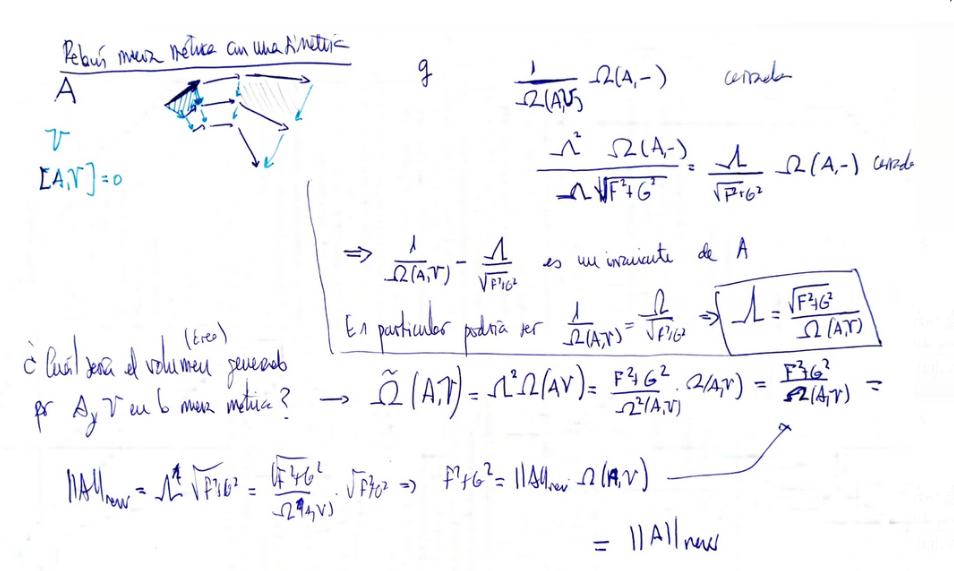
The volume spanned by
What about the length of
On the other hand, the unit normal to
Open questions
- What is the meaning of the curvature of this metric? Let us to classify equations?
- Is there a determining equation for the metric? (see Maple_035 eq 19) Yes
being
Is it easier to solve that the equation for integrating factors?
- What is the role of symmetries in this surface? I think that the commuting symmetries correspond to vector of constant length...
- Is there an isometric embedding of this manifold in
such that the curves are given by intersection of parallel planes with the surface? I think that at least they must be parallel curves inside this surface. The definition and importance is in this paper called "Computing parallel curves on parametric surfaces" by Galvez, Iglesias, Puig-Rey. Could what they call characteristic curves be the geodesics of the surface in this case? - Given the curvature, we have a surface. Can we study what equations would yield this surface?
- Does the geodesics of this metric have a meaning?
- For general vector fields
in we have
The relationship with an integrating factor of the associated 1-form
Nuevo chispazo: orden
(muy poco claro)
Dada una ODE
Además, hopefully las integrales primeras están dando totally-geodesic manifolds, pues estarían hechas de geodeśicas.
Estamos describiendo el espacio con una especie de geodesic polar coordinates generalizadas a dimensión
La métrica puede ser deformada hasta una métrica plana (usando los symmetrising factors), y tenemos un frame, que contiene a
En cierto sentido, sería como si demostrásemos que la cinf-structure da direcciones (familia de conformal metrics) y queremos buscar, de entre todas, aquella que sea plana, buscando las longitudes adecuadas (symmetrising factors).